Sentimental Decluttering: Keep Memories, Reclaim Space
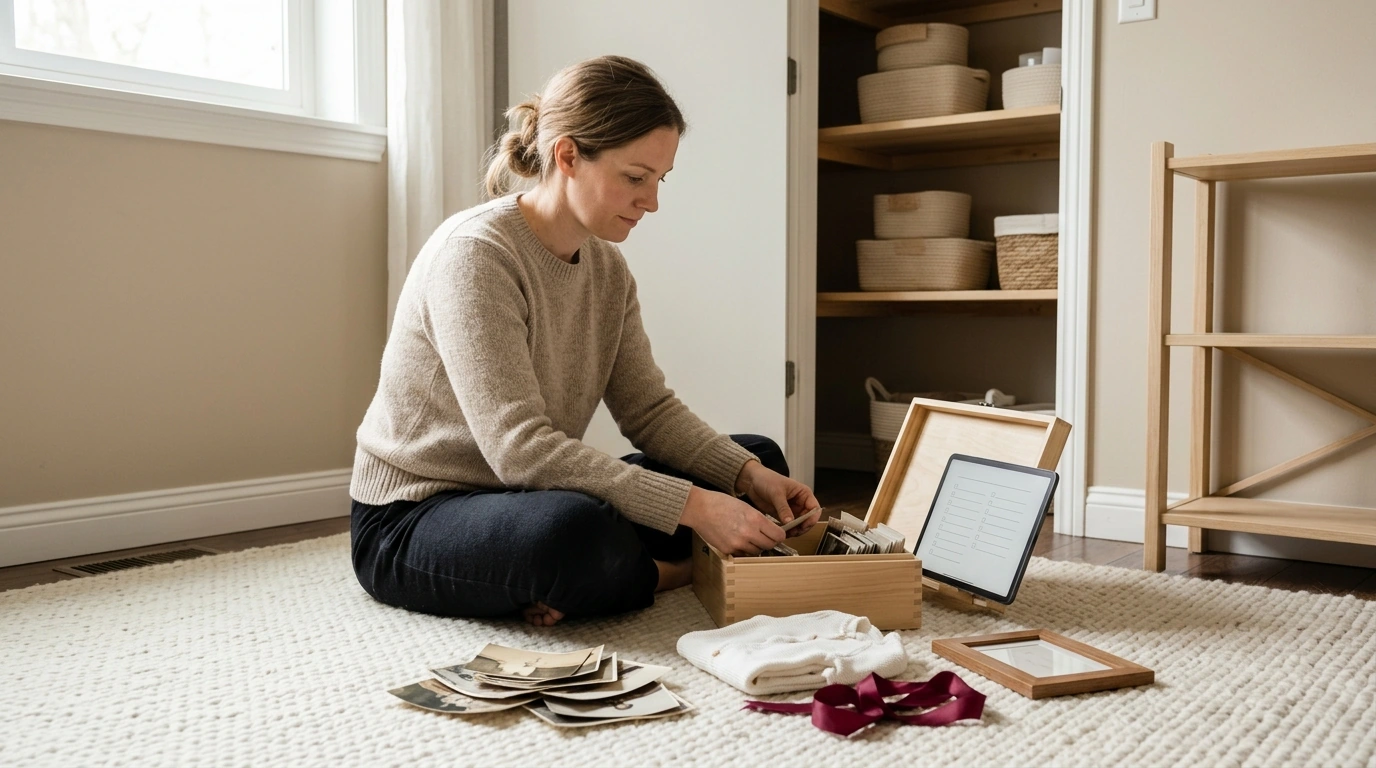
Sentimental clutter deserves a gentler approach
Sentimental clutter is different: it’s not just stuff, it’s stories. A ticket stub can hold an entire summer. A baby onesie can feel like proof that a season of life really happened. The goal isn’t to “get tough” and purge—it’s to create a calm, repeatable system that protects meaning while giving your home its breathing room back.
The “Sentimental Space Saver” approach is built around boundaries, simple decision categories, and storage that keeps memories safe without letting keepsakes take over closets, shelves, and surfaces.
Why sentimental items feel so hard to declutter
Sentimental items often act as memory cues, so it can feel like letting go of the object means losing the person, time, or achievement attached to it. That emotional weight can trigger guilt in familiar forms: “Someone gave this to me,” “This cost money,” or “I might need proof of the memory later.”
Because each item requires an emotional evaluation (not just a practical one), decision fatigue builds fast—especially when sentimental piles grow in hidden spaces like boxes, drawers, and closets. Eventually, those “safe” hiding spots start blocking daily function: you can’t find what you need, you avoid entire rooms, and the home feels more like storage than sanctuary.
Set a clear goal before touching a single box
Sentimental decluttering goes best when the rules are decided before you’re face-to-face with your most emotional items.
- Choose a boundary: one shelf, one bin, one drawer, or one memory box per person.
- Define what space needs to do again: a guest room that can host, a closet you can access, a desk you can use.
- Pick a time container: 20–30 minutes, or one category per day (cards, photos, childhood items, inherited keepsakes).
- Decide outcomes for items not kept: donate, recycle, digitize, gift back, or discard.
| Boundary type | Best for | Example rule |
|---|---|---|
| Container | Mixed keepsakes | Everything must fit in one lidded bin |
| Surface | Display items | Only what fits on one shelf stays out |
| Category | Paper-heavy memories | Keep 10 cards total per year (rest scanned) |
| Time | Hard-to-start projects | One 25-minute session, then stop |
The checklist method: decide with meaning, not momentum
Speed can backfire with sentimental items. Instead of “powering through,” use a steady filter that protects what matters and releases what doesn’t.
- Warm up with certainty: choose five “absolutely yes” items first. These anchor your standards and make the rest easier.
- Use a quick meaning filter: does this represent a core memory, a relationship, or a milestone that still feels relevant?
- Separate object from meaning: sometimes one representative piece, a photo, or a short note can stand in for many items.
- Create a “not now” mini-box: if you feel overwhelmed, set it aside and revisit after your first pass.
- Avoid perfection: the win is reduced volume and improved access, not a flawless archive.
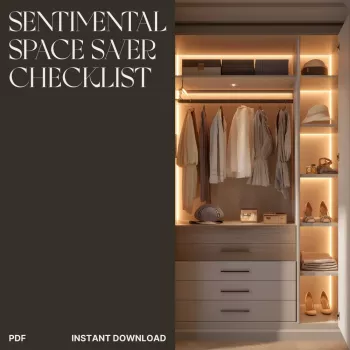
If you want prompts you can follow without overthinking, the Sentimental Space Saver checklist (digital printable) can guide “keep, digitize, display, archive, release” decisions in short sessions.
Four keep categories that make decisions faster
Sorting into clear categories prevents the “keep vs. toss” spiral. Use these four buckets:
- Display: a small set worth seeing often (and dusting) because it adds joy or meaning to daily life.
- Archive: protected items kept for remembrance, not regular use—stored neatly and labeled.
- Use: sentimental items that still serve a function (a quilt, jewelry, a cookbook used weekly).
- Release: duplicates, obligation keepsakes, and items whose meaning is already preserved in another way.
A helpful test: if an item is “special” but you never want to see it, touch it, or store it properly, it’s often obligation—not meaning.
Digitize without creating a new digital mess
Digitizing can be a powerful bridge between “I can’t let it go” and “I need my space back,” as long as it stays selective.
For guidance on protecting irreplaceable paper items, the U.S. National Archives offers practical preservation basics here: Caring for family archives and personal papers.
Storage that protects memories and restores space
If a sentimental “display” item would genuinely brighten a room, it helps to choose pieces that are easy to keep out. For example, a soft, comforting keepsake like the Cute Apple House Kitten Plush – Soft Detachable Cat Plush Toy can fit the “display” category without creating fragile clutter. And if you have a meaningful accessory you actually use, an item like the Elegant Structured Crocodile Pattern Leather Shoulder Bag – Soft Texture can belong in “use” rather than being buried in a closet.
When emotions spike: quick resets that keep you moving
If grief is part of the story, compassionate support matters. The American Psychological Association has a helpful overview here: Coping with grief and loss.
A printable checklist that makes the process simpler
Used in short sessions, it becomes a steady routine instead of a once-a-year emotional marathon. For a ready-to-use format that pairs naturally with a single-container boundary, use the Your “Sentimental Space Saver” Checklist | Digital Decluttering Guide.
FAQ
How many sentimental items should be kept?
Use a boundary instead of a number: one bin, one shelf, or one memory box per person or category. Keep what fits comfortably and can be revisited without stress.
Is it okay to take photos and let the item go?
Yes—photos can preserve the story while freeing space. Add a short caption (who/when/why it matters) so the meaning doesn’t get lost in a huge camera roll.
What should be done with sentimental gifts that aren’t liked?
Appreciate the relationship, not the object. If the gift no longer serves or delights, donate it or pass it on thoughtfully; keeping it out of guilt often turns it into hidden clutter.











Leave a comment