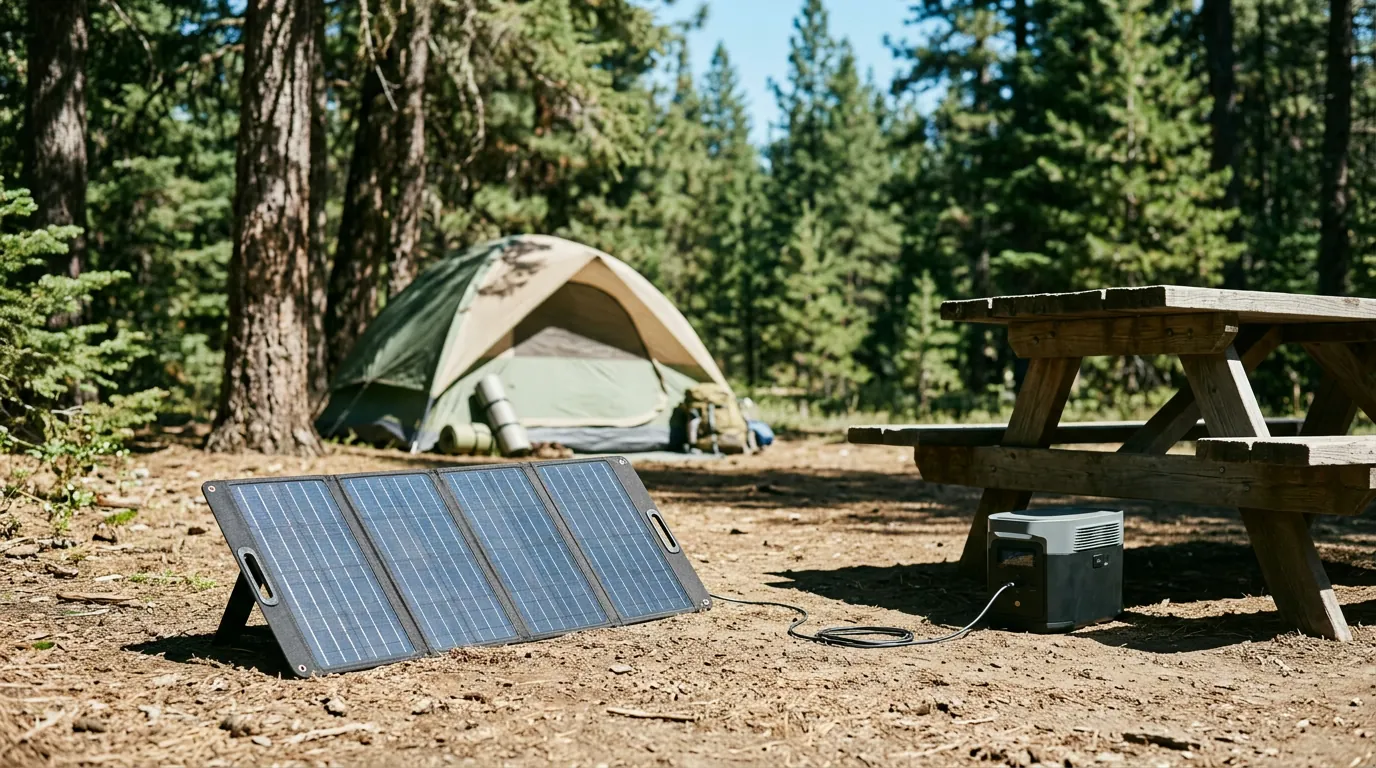
A foldable solar panel is one of the simplest ways to keep a portable power station topped up when outlets are far away. Our 60W Foldable Solar Panel for Portable Power Stations is built for travel-friendly packing and quick setup at camp, on road trips, during backup-power situations, or anywhere sunlight is available. Below is a practical guide to what a 60W panel is best at, how to set it up for better results, and how to match it to the portable power station you already use. For more guidance, see Best Portable Solar Panels and Solar Battery Chargers.
Solar panels rarely operate at their rated wattage all day. Output changes with sun angle, clouds, temperature, and shading. Peak output is most likely when your panel faces the sun directly around mid-day with no shade crossing even a small portion of the surface. On top of that, portable power stations have input limits and conversion losses, so the usable charging rate can be lower than the panel’s rating. For further reading, see Apowking Portable Power Station and Solar Generator.
The most reliable routine is simple: prioritize charging your power station during the best sun window, then use that stored energy later when sunlight drops. If you’d like a quick primer on how solar works, the U.S. Department of Energy and NREL both have solid overviews: Solar Energy Basics (DOE) and Solar Photovoltaic Technology Basics (NREL).
| Scenario | What helps most | Common outcome to plan for |
|---|---|---|
| Clear mid-day sun, panel aimed well | Angle the panel toward the sun; keep it fully unshaded | Fastest charging window of the day; best chance to approach higher output |
| Morning/late afternoon sun | Re-aim the panel occasionally; avoid shade from trees/vehicles | Moderate charging; useful for topping up rather than rapid refill |
| Bright overcast | Use open sky view; avoid partial shade | Reduced charging; still worthwhile for maintaining battery level |
| Hot conditions | Ventilation and avoiding heat buildup can help | Output may dip compared with mild temperatures |
| Intermittent shade (leaves, pole shadow, tent line) | Relocate panel to clear sun; even small shade can matter | Noticeable performance drops; inconsistent charging |
Before connecting any solar panel, confirm your portable power station supports solar charging and check its accepted input range (voltage/current/wattage). This matters more than chasing peak wattage: correct electrical matching and the right connector/adapters help prevent unstable charging, interruptions, or an outright incompatibility.
Many portable power stations can use a 60W panel, but compatibility depends on your station’s supported solar input range and connector type. Match the panel output to the station’s solar input specs and use the correct adapter/cable for a stable connection.
Solar output changes with sun angle, cloud cover, heat, and especially partial shading. Even a small shadow across the panel can reduce power significantly, so re-aiming the panel and keeping it fully unshaded helps steady charging.
Charging the power station first typically gives you steadier, more predictable power. Then you can charge your devices from the station even when sunlight is inconsistent or fading.


Leave a comment