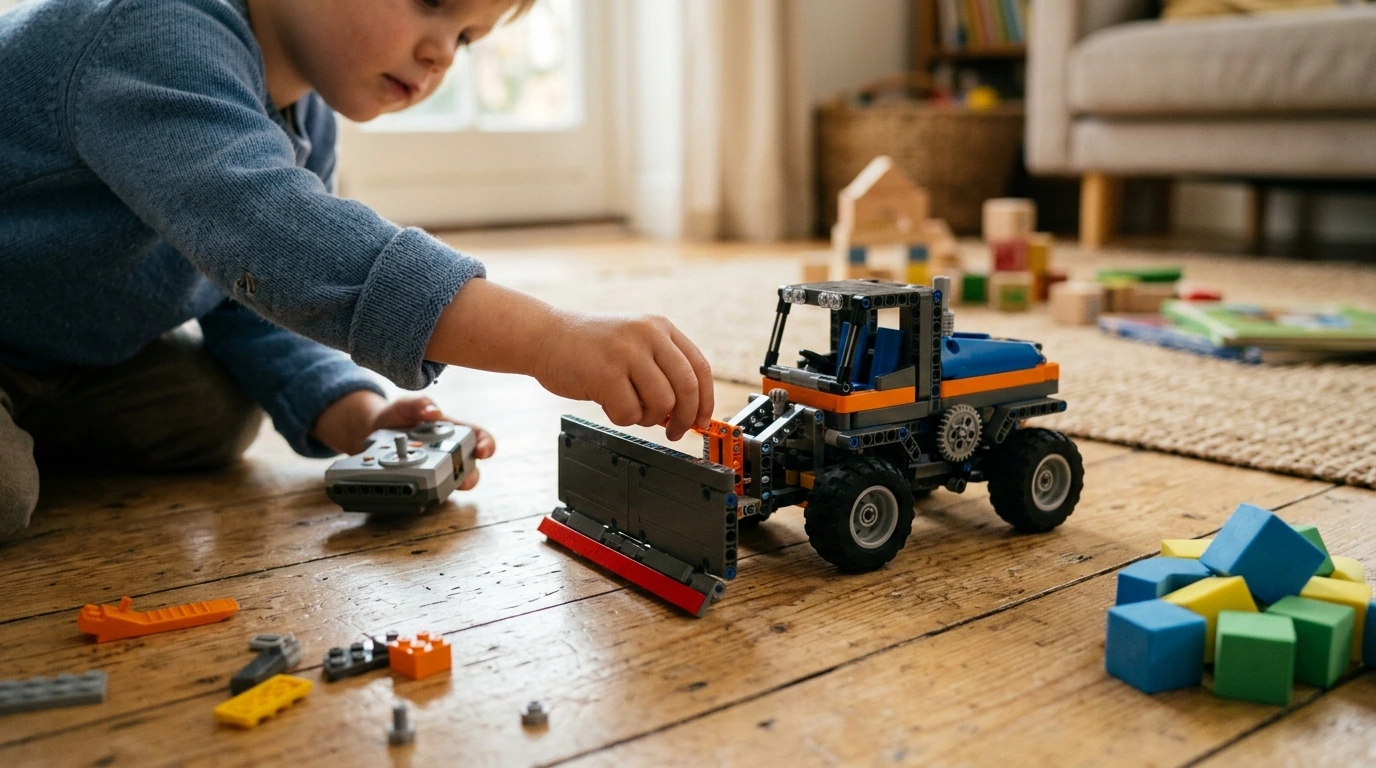
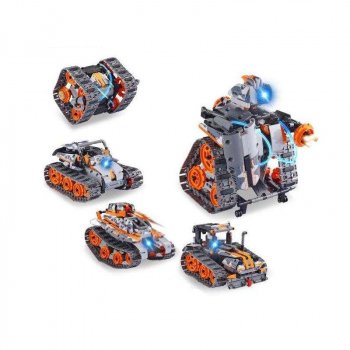
Kids don’t just want to watch a toy move—they want to make it move. Our 5-in-1 RC STEM Building Set turns build time into real problem-solving, then rewards it with remote-controlled action. You get one kit, multiple builds, and lots of chances to redesign, rebuild, and learn how small changes in structure and mechanics affect how a vehicle drives, turns, and handles obstacles.
When a toy offers five builds instead of one, it’s not just extra pieces—it’s extra pathways for learning and play. Here’s why this format tends to stay in rotation longer in real homes.
If you like the “try, test, adjust” rhythm, you’ll recognize it as the same basic loop used in the engineering design process, just scaled to kid-friendly building and play.
Each configuration creates a different kind of challenge, which is why switching models doesn’t feel like “starting over.” You’re practicing improvement—cleaner alignment, faster assembly, fewer leftover parts, and better troubleshooting.
| Build option | Best for | Try this at home |
|---|---|---|
| Robot | Balance, stance, clean turns | Make a small turning course and test wider vs. narrower wheel/track spacing |
| Tank | Traction, steering practice | Compare driving on tile/wood vs. carpet and note where it slows or slips |
| Snowplow | Pushing tasks, attachment strength | Push cotton balls or paper balls first, then try slightly heavier foam blocks |
| Build 4 | Creative reconfiguration | Swap a front section from another build and see how handling changes |
| Build 5 | Speed vs. control experiments | Adjust weight distribution with safe, removable add-ons (like a small paper clip bundle) and test turning |
You don’t need worksheets for meaningful STEM moments. When kids build something that has to move, steer, and survive bumps, learning becomes part of the fun.
STEM learning also supports skills schools care about broadly, as outlined by the U.S. Department of Education’s STEM resources.
Once you’ve built a model, you can stretch the play without turning your home into a full-time racetrack.
Building and handling small parts can also support fine-motor development in hands-on play (see the American Academy of Pediatrics’ overview on fine motor skills).
It’s both—the fun comes from building a model, testing it with RC control, then rebuilding into another configuration. For the best experience, alternate short build sessions and short drive sessions so you get frequent “finished and working” moments.
Break the build into smaller chunks: sort pieces first, double-check alignment, and make sure connections are firmly seated. Teaming up helps too—one person can read steps while the other assembles, and the troubleshooting itself is part of the STEM value.
Rotate through the five models, then add mission-style play like obstacle routes, pushing challenges, and surface testing. Keeping modifications small and controlled (change one thing, test once) makes it feel like a real experiment instead of random rebuilding.



Leave a comment